The MLK Speech They Don’t Want You to Remember: “The Birth of a Nation”
“Tomorrow, the speech should be—and always should be—”The Birth of a Nation.”
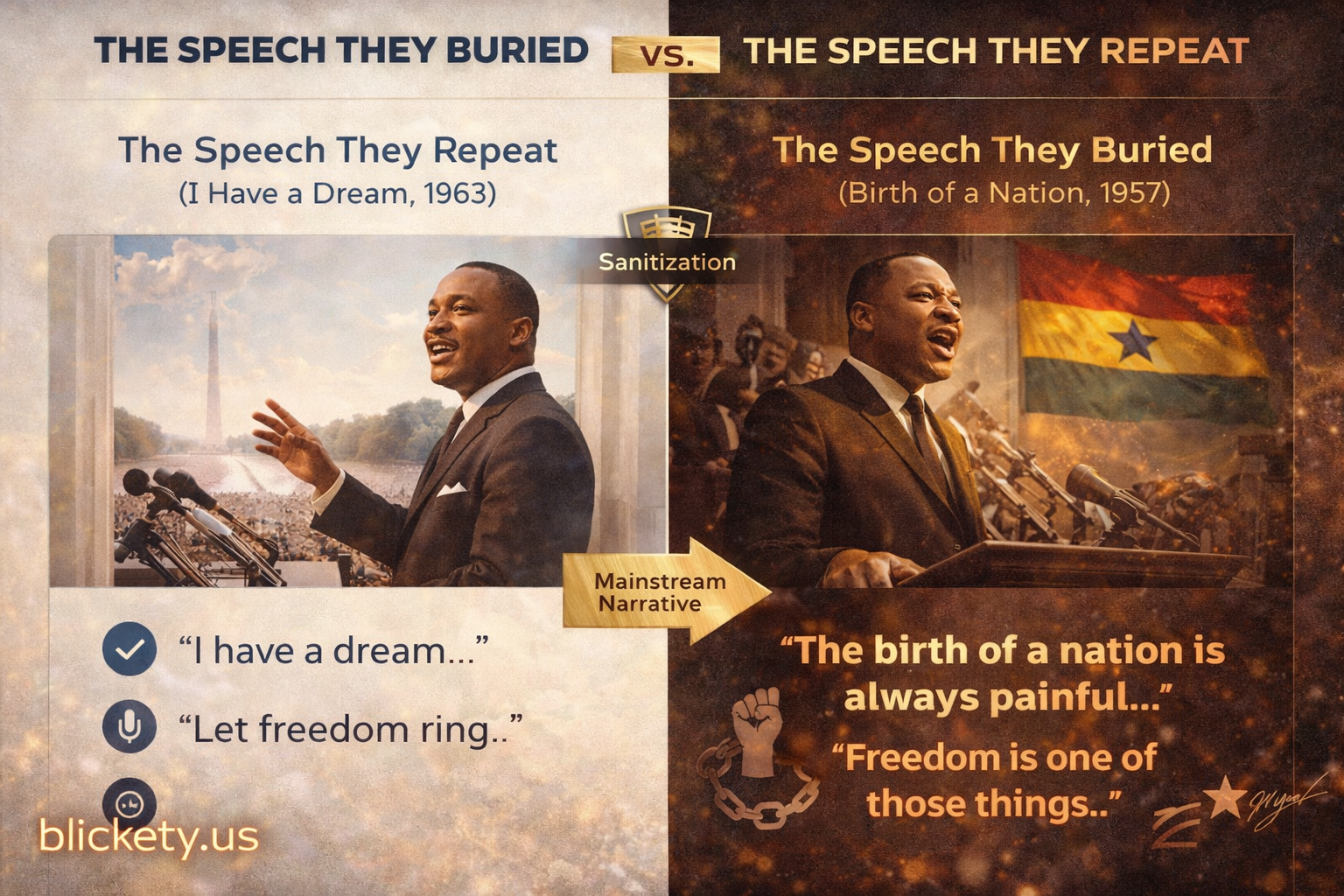
Not the 1963 “I Have a Dream” address that gets looped on every holiday playlist like a safe, sanitized lullaby. Not the one that white moderates can quote while still clutching their comfort and denying reparations, housing justice, or any material redistribution of power.
The MLK Birth of a Nation speech I’m talking about is the one Martin Luther King Jr. gave on April 7, 1957, at Holt Street Baptist Church in Montgomery, Alabama. Furthermore, this was shortly after he returned from witnessing Ghana’s independence celebrations on March 6, 1957—the first sub-Saharan African nation to break free from colonial rule.
This is the speech titled “The Birth of a Nation” (sometimes referenced as “Ghana and the Birth of a Nation” in historical records). Consequently, it’s the one that still burns with a clarity and fury that the mainstream canon rarely lets breathe. It’s the speech that positioned African independence not as distant inspiration but as blueprint—as proof that Black self-governance wasn’t a dream deferred but a nation being born.
This is Afro-Futurism’s origin story: witnessing the future arrive in real-time and bringing that vision home to transform the present.
The Context They Don’t Teach: When MLK Witnessed the Future
In March 1957, King wasn’t just invited to Ghana’s independence day—he was treated as a dignitary. Kwame Nkrumah, Ghana’s visionary first president and Pan-African architect, seated King among heads of state. For those historic days, King lived in a world where Black leadership wasn’t a plea bargaining for crumbs. It was the government.
The Moment That Changed Everything
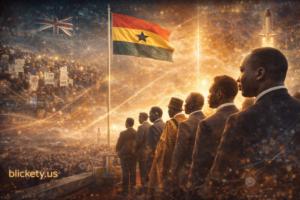
King watched the Union Jack come down and the Black Star rise. Moreover, he witnessed Black people—his people, separated by ocean but not by struggle—step into full political power. He saw Black men and women voting freely, legislating, governing. He saw what liberation looked like when it stopped being theoretical and became constitutional.
Then he flew back to the United States.
And he was met with suspicion, surveillance, and thinly veiled hostility from the American establishment. Vice President Richard Nixon, who had also attended Ghana’s independence, reportedly asked King why he was there—not out of curiosity but with that classic American imperialist tone dripping with contempt: What business does a Negro preacher have at the birth of a Black nation?
The CIA and State Department were already monitoring Nkrumah as a “communist threat.” They didn’t appreciate seeing an American Black leader embraced as an equal by a new African head of state. It disrupted their carefully constructed narrative that Black people were incapable of self-governance, that freedom was something white powers graciously granted rather than something oppressed peoples seized.
So when King stood in Montgomery days later to deliver the MLK Birth of a Nation speech, he didn’t give them comfort. He gave them prophecy. He gave them vision. He told Black people: I have seen our future, and we are already becoming it.
The Speech Itself: Prophecy Disguised as Sermon
The full MLK Birth of a Nation speech transcript is preserved in The Papers of Martin Luther King, Jr., Vol. 4, though it receives a fraction of the attention lavished on “I Have a Dream.” Let’s resurrect some of its most powerful moments:
On Witnessing Black Dignity as Government Policy
“For the first time in my life, I saw Black men and women treated with dignity… I saw them go to the polls and vote… I saw them sit in the legislature and make laws… I saw them in the executive branch carrying out the laws… And I said to myself, ‘This is what God wants for all His children.'”
This wasn’t metaphor. This was King describing the future he had actually witnessed—and declaring it inevitable for Black Americans. He had seen the blueprint. The architecture of Black freedom wasn’t abstract theology; it was concrete governance happening in Accra.
On Liberation as Inevitable Birth
“Ghana reminds us that oppression can be defeated… The birth of a nation is always a painful process, but once the child is born, nothing can stop it from growing.”
Notice the language: not “if” the nation is born, but “once.” Not a dream that might arrive if we’re patient enough, but a birth already in labor. Consequently, King positioned liberation as biological inevitability—messy, bloody, irreversible. You can’t negotiate with a birth. You can only prepare for the world it creates.
This is Afro-Futurist temporality at its purest: the future isn’t distant possibility—it’s present reality breaking through.
On the Non-Negotiability of Freedom
“There are some things in this world that don’t change just because white folks say they won’t. Freedom is one of them.”
Read that again. Let it settle. This is not the MLK of carefully worded appeals to American conscience. This is the King who had just witnessed an entire nation tell the British Empire to pack its bags—and now he was telling Black Americans that White approval was irrelevant to Black liberation.
Freedom doesn’t arrive through permission. It arrives through assertion. Through birth.
Connecting Ghana to Montgomery: One Struggle, One Future
King explicitly connected Ghana’s independence to the Montgomery Bus Boycott and the larger Black freedom struggle in America—not as polite analogy but as proof that colonial empires and Jim Crow were both dying systems. Similarly, he argued that the same forces that had held Ghana under Britain were the same ones holding Black Americans under segregation.
And both were doomed. Not because of moral persuasion, but because liberation was already being born.
Why This Speech Still Threatens Power
The MLK Birth of a Nation speech remains buried in mainstream narratives for the same reason the CIA monitored King’s Ghana trip: it’s dangerous. It positions Black liberation not as something white moderates can grant or withhold, but as an inevitable transformation already underway.
The Radical King They Sanitized
Mainstream culture has spent decades domesticating Martin Luther King Jr. into a figure acceptable to the very power structures he opposed. They quote “content of their character” while ignoring his calls for reparations, economic redistribution, and anti-imperialist solidarity. They celebrate the dreamer while erasing the prophet.
But the MLK Birth of a Nation speech reveals the King who:
- Saw African independence and American Black liberation as one interconnected struggle
- Understood colonialism and Jim Crow as the same white supremacist system
- Positioned freedom as something Black people would take, not something white people would give
- Connected his movement to global anti-colonial revolution that threatened American empire
This King couldn’t be controlled. This King couldn’t be safely quoted at corporate diversity trainings. This King had to be buried.
The Pan-African Vision America Feared
When King returned from Ghana and delivered the Birth of a Nation speech, he was doing more than reporting on a nice trip. Instead, he was announcing that Black people globally were on the move—and American apartheid’s days were numbered.
The Pan-African implications terrified American intelligence agencies and political establishment. If Black Americans started seeing themselves as part of a global majority fighting colonialism rather than an isolated minority begging for rights, the whole justification for segregation collapsed.
Moreover, if African nations could achieve independence and self-governance, it exposed the lie that Black people needed white supervision. Ghana’s success proved America’s excuses were fiction.
The Afro-Futurist Framework: Liberation as Time Travel
What makes the MLK Birth of a Nation speech profoundly Afro-Futurist isn’t just its content—it’s its relationship to time itself.
King as Time Traveler
When King went to Ghana, he traveled to the future. He witnessed what Black self-determination looked like when fully realized. Then he returned to 1957 Montgomery—still deep in Jim Crow—carrying the future in his consciousness.
The speech was his attempt to collapse that temporal distance. To tell Black Americans: The future I saw isn’t decades away. It’s already being born. We just have to midwife it into American reality.
This is the essence of Afro-Futurism: understanding that Black liberation exists outside linear white supremacist time. Consequently, it’s simultaneously ancestral (we’ve always been free), present (we’re becoming free), and future (we will be free). Ghana proved all three could coexist.
Prophecy as Blueprint
When King spoke prophetically about freedom’s inevitability, he wasn’t making mystical predictions. Rather, he was reading the architecture of the future he’d already witnessed. He had the blueprint. He knew what the liberated nation looked like because he’d stood in it.
This is why his language shifted from the conditional (“if we can achieve”) to the declarative (“when the nation is born”). He had seen the future. The question wasn’t whether Black liberation would arrive—it was how quickly the present would catch up.
The Nation Still Being Born
Sixty-eight years after the MLK Birth of a Nation speech, we’re still in labor. The nation King witnessed in Ghana—the one he prophesied for Black America—is still fighting to fully emerge.
But the speech reminds us: births don’t stop mid-process. Once started, they complete. The question isn’t if—it’s when. And what we do to hasten the arrival.
What Would King’s Ghana Vision Look Like Today?
If we apply the Afro-Futurist framework of King’s Birth of a Nation speech to our current moment, what does the nation being born look like now?
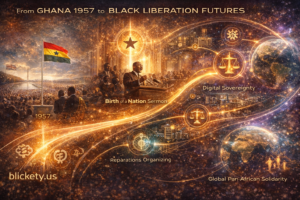
Digital Sovereignty and Tech Liberation
Ghana achieved independence from physical colonialism. Today’s birth includes independence from digital colonialism—Black ownership of data, platforms, and technological infrastructure. The nation being born includes Black people controlling our digital futures, not just participating in Silicon Valley’s extractive systems.
This means Black-owned tech companies that serve our communities first. Black data sovereignty that protects our information. Black digital currencies that circulate wealth within our economies. The Ghana King witnessed governed itself. The digital nation we’re birthing must govern its own technological destiny.
Economic Independence and Reparative Justice
King saw Ghana’s economic sovereignty—a nation controlling its own resources and development pathways. The American birth he prophesied requires similar economic transformation: reparations, land ownership, Black banks controlling community capital, cooperative economics that keep wealth circulating internally.
The nation being born doesn’t beg for inclusion in extractive capitalism. It builds parallel economies rooted in mutual aid and collective ownership—the same principles that sustained us through slavery, Jim Crow, and every attempt to economically destroy us.
Global Black Solidarity Networks
Ghana’s independence was part of a continental Pan-African wave. Today’s birth includes global digital networks connecting African diaspora struggles—from #EndSARS in Nigeria to Black Lives Matter globally. The nation transcends borders because oppression transcends borders.
Social media, when wielded correctly, allows the same solidarity King witnessed in Accra to manifest instantly across continents. The nation being born is both local and planetary—rooted in specific communities while connected to global Black liberation movements.
Space as the Next Frontier
Afro-Futurism reminds us that liberation includes the cosmos. As private space exploration accelerates, the nation being born must claim space itself. Black astronauts, Black space entrepreneurs, Black communities imagining futures beyond Earth’s boundaries—this is the Ghana vision extended to the stars.
King witnessed one boundary (colonialism) shattered. We’re shattering others: digital, economic, planetary. The birth continues.
Why Tomorrow—And Every Day—Should Center This Speech
The “I Have a Dream” speech is safe because it asks nothing threatening of white listeners. It lets them imagine gradual progress, colorblind futures, and comfortable integration without material redistribution of power or wealth.
The MLK Birth of a Nation speech is dangerous because it announces: The transformation is already happening. You can participate or get trampled. But you cannot stop what’s being born.
For Young People Seeking Authentic History
If you’ve sensed that the MLK taught in schools feels incomplete—sanitized, defanged, useful mainly for corporate DEI presentations—trust that instinct. The full King was revolutionary. He connected American racism to global imperialism. He demanded economic transformation, not just voting rights. He saw Black liberation as part of worldwide anti-colonial struggle.
The Birth of a Nation speech is your entry point to the real King. The one who traveled to the future, witnessed Black self-governance, and came back declaring it inevitable here.
For Educators Fighting Sanitized Curriculum
Teaching this speech means teaching that:
- African independence and Black American civil rights were the same struggle
- King was monitored by U.S. intelligence because his vision threatened empire
- Black liberation was never about white people’s comfort or approval
- Freedom is something seized, not granted
- The future King witnessed is still being born—and we’re all midwives
For Activists Building Current Movements
The MLK Birth of a Nation speech offers strategic wisdom: liberation movements need to witness their own futures to sustain hope through brutal present circumstances. King could endure Montgomery’s violence because he’d seen what victory looked like in Accra.
Where do current activists witness the future? In mutual aid networks that prefigure cooperative economies. In Black-owned tech building digital sovereignty. In reparations pilots creating wealth redistribution models. In community land trusts reclaiming territory.
Each is a Ghana—a working model of liberation that proves it’s not theoretical. It’s already being born.
The River That Doesn’t Ask Permission
The speech ends where prophecy always ends: with the inevitability of water finding its path.
The Blue Nile doesn’t ask the banks for permission to flow. It doesn’t negotiate with obstacles. It carves through mountains, floods plains, and keeps moving toward the sea because that’s what rivers do.
Black liberation is that river. Ghana was proof it was flowing. The Montgomery Bus Boycott was proof it was flowing. Every subsequent victory—voting rights, economic justice movements, Black political power—is proof it continues flowing.
The MLK Birth of a Nation speech was King announcing: I’ve seen where this river goes. I’ve stood at the delta. The ocean is real. The nation exists. We’re just traveling toward what’s already been born.
Not the dream deferred.
The nation being born.
The future arriving.
The river that doesn’t ask—it flows.