Reclaiming the Gaze: An Afro-Futurist Voyage Through Tate Modern’s Unseen Canons
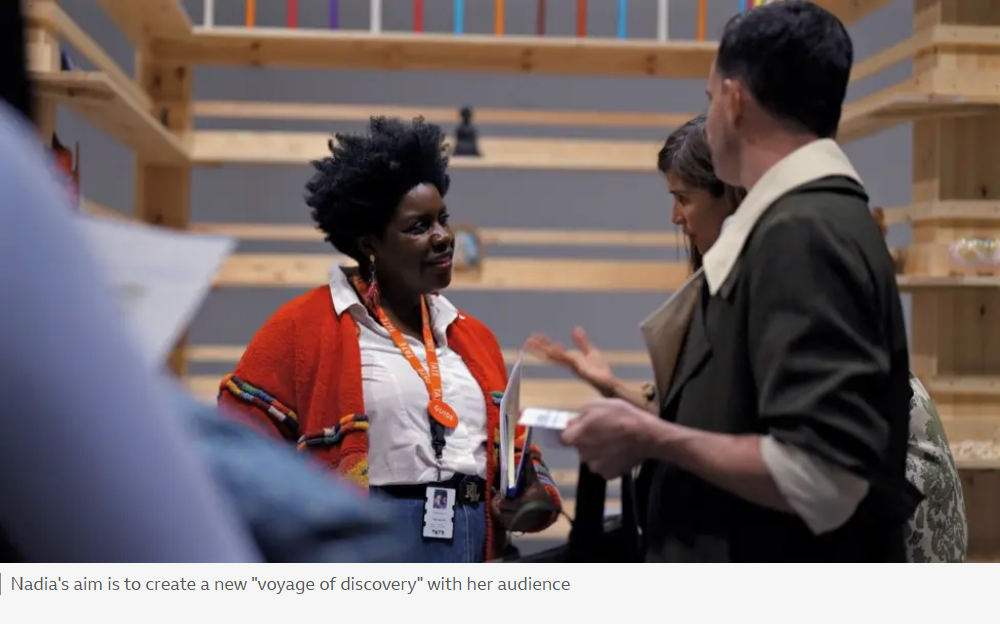
The gallery is a portal. The white walls of Tate Modern are not a void, but a contested space—a digital-age canvas where the ghosts of colonial catalogs meet the vibrant, living signal of **African modernism at Tate Modern**. Here, guide Nadia Denton does not merely narrate art history; she operates as a **cultural cryptographer**, transmitting frequencies long suppressed by the static of stereotype. “The work we look at,” she states, cutting through the noise, “doesn’t look ‘African’.” This is not an admission of absence, but a declaration of revolution. It is the sound of a limiting archive being overwritten by a liberating, complex, and profoundly futuristic code.
This is the work of the 21st-century griot. Nadia’s tours are not passive viewings; they are **active decryption sessions**. She stands before Ibrahim El-Salahi’s *Reborn sounds of childhood dreams*—a Sudanese vision where calligraphic forms pulse with organic, almost cybernetic life. This is not a “traditional” mask; it is a **memory file from a future past**, where Arabic script merges with biomorphic shapes, suggesting a consciousness that is both ancestral and uploaded. Nadia’s mission is clear: to make visitors feel “that the art is something they can claim.” This is the core of Afro-Futurist practice—not just observing culture, but **activating its dormant data and claiming its power as a tool for self-definition**.
#### **Decoding the Textures of Fracture & Repair**
The voyage moves to the textured landscape of Malian artist Abdoulaye Konaté’s *Intolerance*. Here, the medium is the message, woven from a symphony of found materials: vibrant textiles, discarded flip-flops, spent bullet shells, fragile notebook paper. This is not mere assemblage; it is **social forensics**. Konaté constructs an abstract scene of a fallen figure, using materials that speak of daily life, conflict, and resilience. The bullet shell is data-point of violence; the flip-flop, a relic of human movement; the notebook paper, a substrate for stories interrupted.
Nadia guides the group through this material code. She does not deliver a monolithic interpretation but opens a **shared interpretive space**, asking, “How does it make you feel?” This transforms the gallery from a temple of fixed meaning into a **participatory network**, where understanding is co-created. The artwork becomes a diagnostic tool, mapping the “fractures that emerge when communities turn against one another,” while its very construction—stitching, layering, combining—offers a blueprint for repair. It is **ancestral textile technology applied to social healing**.
#### **The Sovereign Sentinel: Architectures of Black Feminist Power** 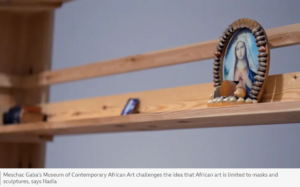
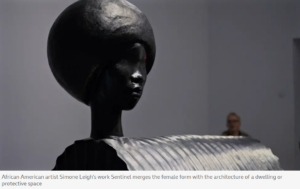
Next, the group encounters a sentinel. Simone Leigh’s glossy black sculpture rises, a formidable fusion of the female form with architectural dome—a body that is also a shelter, a head that is also a watchtower. Nadia invites speculation: “A tunnel?” suggests one voice. “A bomb shelter,” offers another. This collaborative naming is a ritual of reclamation.
Leigh’s work is rooted in Black feminist thought, creating figures that are “part body, part home.” Nadia reframes them as **sovereign architectures**. They are not vulnerable forms on display; they are autonomous structures—**biotechnical fortresses** that protect and project interiority. “They’re majestic, intimidating and powerful,” Nadia affirms. This is Afro-Surrealism in action: taking the historical trauma of the Black female body, subjected to gaze and violation, and transmuting it into an icon of unassailable, futuristic power. The sentinel does not ask for inclusion in the canon; it guards the gate to a new one.
#### **From Colonial Archive to Living Database**
Nadia’s work exists within a wider systems update occurring across museum infrastructure. Tate Modern’s sell-out exhibition on Nigerian modernism signals a shifting public appetite. Yet, Nadia openly acknowledges the colonial operating system upon which these institutions were built—a system that dictated which artworks were looted, preserved, and deemed worthy of display.
Her response is not to reject the museum, but to **hack its space**. “Just by being in front of an artwork or speaking to it we can bring life to it,” she asserts. “We can change how that object is perceived and have some impact on its future legacy.” This is the griot’s power: to breathe activating code into dormant objects, transforming static exhibits into nodes in a living network of diasporic memory.
The final portal is Meschac Gaba’s *Museum of Contemporary African Art*, a cross-shaped wooden structure housing a cosmos of over 75 religious and cultural objects. This is not a curated collection but a **conceptual database**. By placing symbols from Buddhism, Christianity, Islam, Vodún, and others in dialogue, Gaba performs a radical act: he declares that African art and thought are not a primitive, isolated category. They are a **syncretic, global operating system**, capable of containing multitudes and engineering new spiritual technologies.
Nadia, our griot-guide, measures her success by connection: “If they’re still with me at the very end, I know I’ve done a good job.” But her impact is deeper. She is not just guiding tours; she is **bootstrapping a new perception**, teaching visitors to see African art not as a relic of a frozen past, but as a dynamic, visionary, and endlessly evolving **protocol for the future**. The Tate’ walls are listening. The sentinels are standing guard. The voyage of discovery is just beginning.
—
*Continue the journey of reclamation and vision. Explore more at **blickety.us**—where culture is not just observed, but activated.*