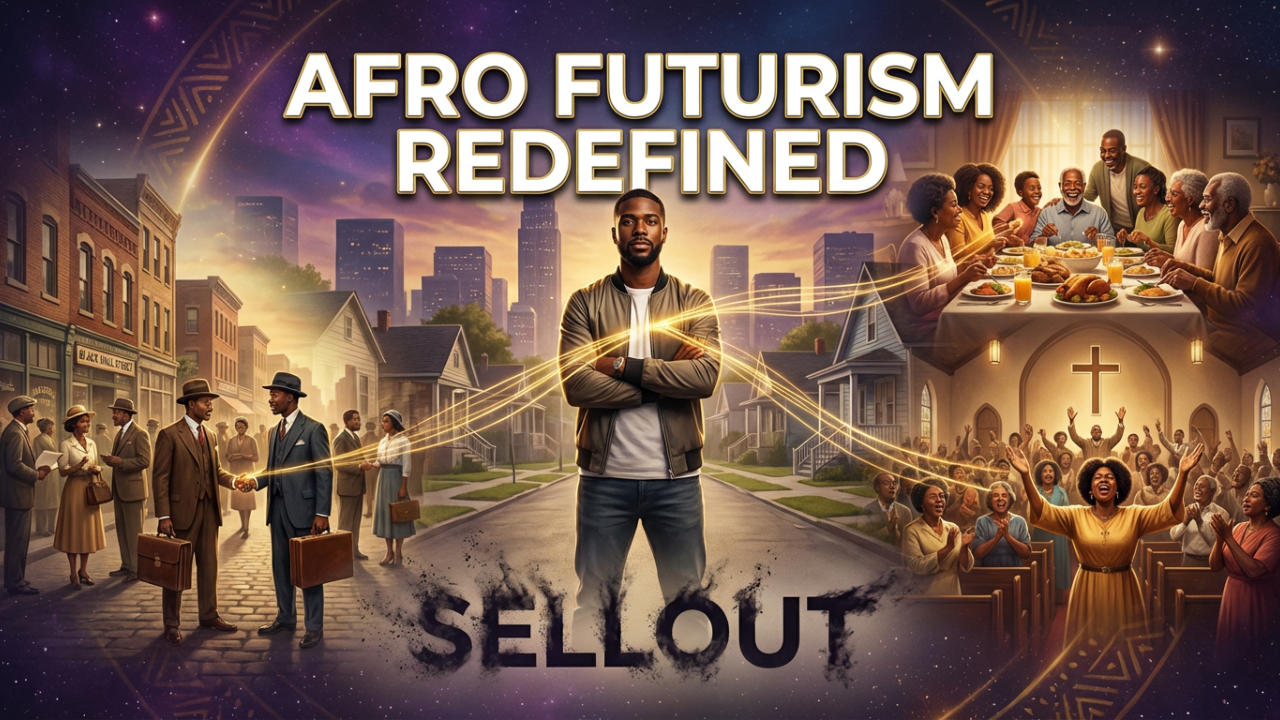
When “Sellout” Really Means Think Different: The Everyday Black Man’s Conservative Blueprint
You're not trying to be controversial when you value God. When you believe in working for what you have. You think a man should lead his household. When you question whether the government actually helped us—or quietly destroyed us. You read, you think independently, you don't follow the crowd.
And somebody called you a sellout.
Here’s the truth nobody wants to say out loud: the principles you’re holding aren’t betrayal. They’re the exact same principles that built everything our ancestors created.
What Black Conservative Self-Reliance Actually Means
This isn’t about Republican or Democrat. This is about a philosophy that predates both parties by centuries. Black conservatism is a philosophy emphasizing traditionalism, self-sufficiency, and strong cultural values within the context of the Black church. Black conservatives find common ground with Black nationalists through their shared belief in Black empowerment and the theory that Black people have been duped by the welfare state.
Read that again. Black conservatives and Black nationalists agree on the same thing: we need to stop depending on systems designed to keep us dependent.
Black conservatism isn’t about unquestioning loyalty to a political party or ignoring the struggles of our community. It’s a philosophy of empowerment—a practical approach to tackling the deep-seated issues that have plagued our neighborhoods for far too long.
The everyday Black man who values faith, family, and self-determination isn’t selling out. He’s carrying forward.
The Proof Is in the History: What Actually Built Us
Black Wall Streets and Freedom Colonies were built without reliance on government aid, a victimhood mentality, or identity politics. They thrived through entrepreneurship, self-efficacy, community cohesion, and traditional values.
Greenwood’s success was built on the principle of economic interdependence—individuals invested in businesses, those businesses created jobs, and the resulting wealth was reinvested in education, housing, and cultural development . Every dollar spent in the Greenwood District circulated within the neighborhood at least 36 times. No government program created that. No political party gifted that.
Black people built it themselves.
The Black church served as the moral and social foundation—church socials, Bible study, and praise meetings encouraged social cohesion, heightened community, and nurtured hope in the face of discrimination and violence. By the 1950s, the infrastructure of Black churches and the moral resilience they encouraged had laid the foundation for everything that followed.
God. Family. Work. Community. Self-reliance. These weren’t conservative talking points—they were survival technology. The same technology that kept Black families intact through slavery, Jim Crow, and every horror this country threw at us.
 What Left-Wing Policies Actually Did to Us
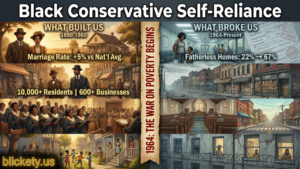
Here’s where it gets uncomfortable. Thomas Sowell—one of the most respected Black economists in American history—concluded: “A vastly expanded welfare state in the 1960s destroyed the Black family, which had survived centuries of slavery and generations of racial oppression. In 1960, before this expansion, 22 percent of Black children were raised with only one parent. By 1985, 67 percent were raised with either one parent or no parent”.
Between 1890 and 1950, the marriage rate was actually higher among Black women than white women. But everything changed with the expansion of the welfare state—it divided the household and created a dependency on government.
The welfare explosion jumped from 4.7 million to 9.7 million between 1966 and 1970 alone. This new version of welfare took over poor Black communities, becoming a defining influence. Black America fell into economic dependence and cultural ruin—within just a matter of years, successive generations of Black children barely knew their fathers.
Roughly 75 percent of Black children were born to married two-parent families when the “War on Poverty” began in 1964. By 2008, the percentage born out of wedlock exceeded 72 percent.
Slavery couldn’t do what the welfare state did. That’s not a conservative talking point—that’s Walter E. Williams, economist. That’s Thomas Sowell, Harvard-educated. That’s the data.
The programs designed to “help” us systematically made the Black father irrelevant, turned government into the provider, and cracked open the foundation our ancestors spent centuries building.
The Afro-Futurist Frame: Conservative Values as Liberation Technology
Here’s the pivot that matters: Black conservative self-reliance isn’t looking backward. It’s looking forward.
Reviving Black Wall Street is founded on an ambitious, self-reliant model of entrepreneurship—one that simply asks the government to get out of the way and let communities innovate. It allows individuals to take control of their economic futures, reducing reliance on external systems and creating a foundation for long-term resilience.
That’s not conservatism as a political label. That’s Afro-Futurism as economic strategy. The same principles that built Greenwood can build the next Black economic powerhouse—but only if we stop waiting for permission and start building.
The everyday Black man who thinks independently, leads his family, builds his own wealth, and questions whether the government is actually his friend? No, not a sellout. He’s practicing the exact same philosophy that made Black Wall Street possible. This man is carrying the Black church’s moral foundation into 2026. He’s choosing self-determination over dependency.
Why They Call You Sellout (And Why It Doesn’t Stick)
Conservative thought has deep historical roots in the African American community, and its proponents have long been engaged in the struggle for racial equality, seeing conservative ideology as a legitimate solution to the ills that afflicted their community.
The sellout label exists to silence independent thinking. It says: “Stay in line. Don’t question the narrative. Don’t think for yourself.” But our ancestors—the ones who built Black Wall Street, who founded the Black church, who kept families together through unimaginable oppression—they all thought independently.
Booker T. Washington valued economic self-sufficiency. Frederick Douglass valued personal responsibility. The Black church taught moral accountability. These weren’t sellout ideas. They were the foundation.
The everyday Black man doesn’t need a party. He needs the principles that actually work:
God — moral compass, community anchor, source of strength
Family — the unit that builds everything else
Self-reliance — the only thing no one can take from you
Independent thinking — the skill that separates leaders from followers
That’s not selling out. That’s remembering who we actually are.
The sellout label loses power when you understand the history behind the values it’s trying to silence. Share this story. The everyday Black man’s blueprint deserves to be seen.