
Holding Space: When Black-Owned Austin Businesses Become Time-Travel Technology
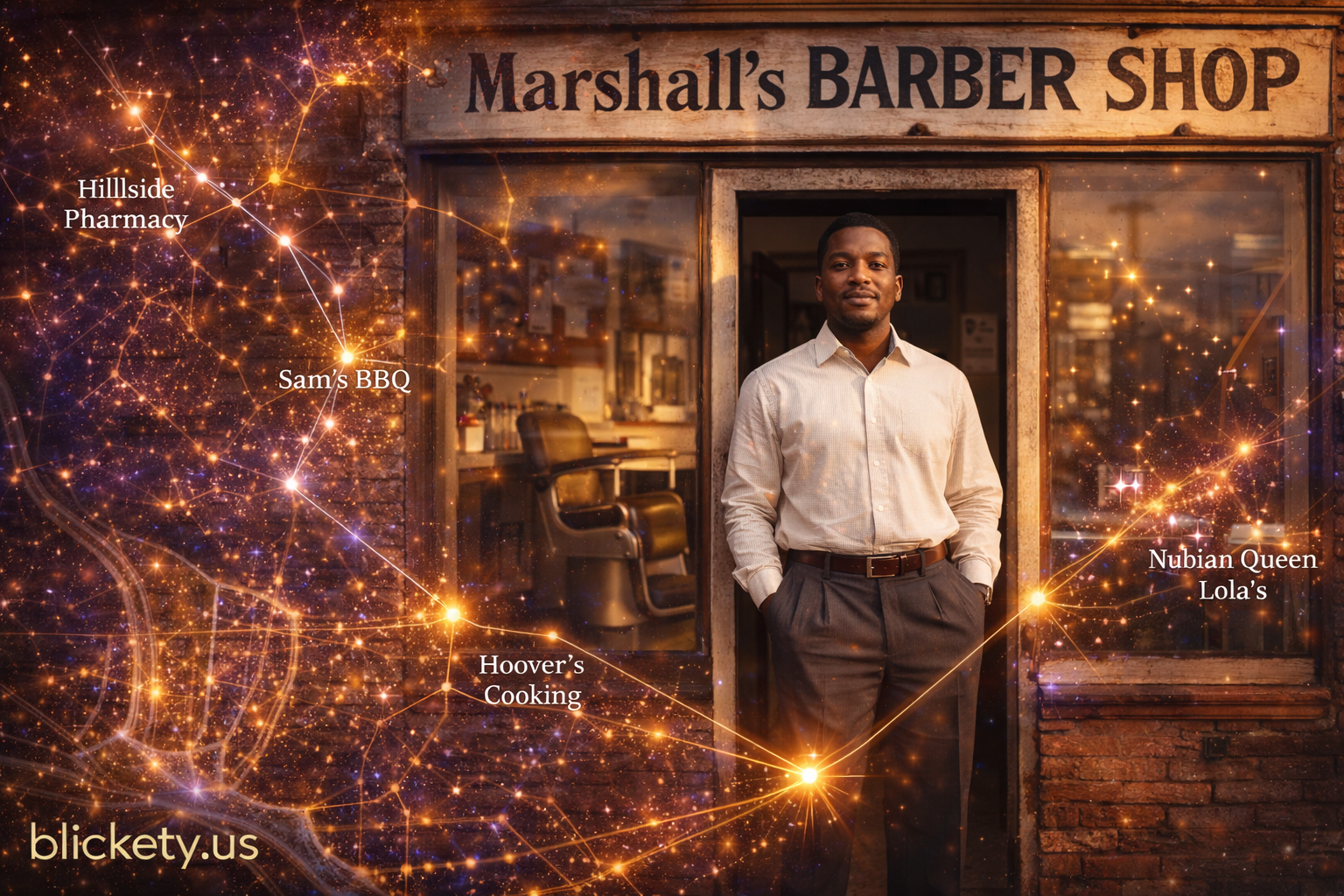
Kevin Asperry stands in the doorway of Marshall’s Barber Shop on East 12th Street—one of the few remaining Black-owned Austin businesses on a corridor that once pulsed with Black life, music, and commerce. Behind him, vintage barber chairs hold more than hair. They hold memory. They hold resistance. They hold space.
This is what photographer Steven Hatchett captures in “Holding Spaces,” his exhibition at Austin Public Library’s Central location celebrating Black entrepreneurs who have built spaces that feed, nurture, and reflect their communities, even as the city around them changes FinancialContent.
But this isn’t just photography. This is documentation of time-travel technology—because in a city actively erasing Black presence, every Black business that survives becomes a portal connecting past to future.
When “Holding Space” Means Holding Ground
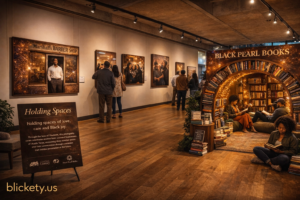
“Holding Spaces” centers Black-owned businesses as vital “third spaces”—places of gathering, safety, and cultural continuity beyond home and work Axios. Through large-scale portraits at the Central Library’s second-floor Southwest Gallery (710 W. César Chávez St.), Hatchett documents institutions like Black Pearl Books, Luv Fats Ice Cream, Down South Cajjun Eats, Kicking It ATX, Riches Art Gallery, Homestead Hub, and Shag Noir Salon.
Hatchett, who’s lived in Austin eight years and co-founded _OFCOLOR (a nonprofit arts alliance uplifting artists of color), frames the project around his respect for Black artists and cultural spaces already present. Coming from Chicago where “Black history is more rooted in the community,” he wants to create that kind of grounded institutional memory for Austin, where many Black historic neighborhoods have faced decimation from gentrification Southwestcontemporary.
The statistics are brutal: Between 2000 and 2010, Black residents in Central East Austin neighborhoods flanking East 11th and 12th streets decreased by 60% WordPress. Black Austinites have been moving to suburbs like Pflugerville, Round Rock, Del Valle, and Manor Medium as homes once selling for $60,000 twenty years ago now command prices that erase generational belonging.
But erasure isn’t complete as long as businesses keep holding space.
The 1928 Blueprint for 2026 Displacement
In 1928, Austin implemented racial zoning that forced Black residents to East Austin by placing all facilities and institutions for Black residents east of what is now Interstate 35 WordPress. City planners literally drew maps confining Black life to specific coordinates.
Nearly a century later, the “Eastern Crescent” historically home to Austin’s most vulnerable population has seen the highest rise in housing costs FoundSF, completing the cycle: first segregate, then gentrify, then displace.
Dr. Amanda Masino of Huston-Tillotson University, who researches “ZIP code destiny,” notes: “It’s unusual for a city to have such fast growth and have such a displacement of the Black population” Medium.
Yet Black-owned Austin businesses refuse the script. Marshall’s Barber Shop still cuts hair on 12th Street. Black Pearl Books still sells stories. Luv Fats still serves ice cream flavors inspired by family and heritage. Together, their work tells a larger story about belonging, resilience, and what it really means to hold space for each other in a city that’s still learning how to do the same FinancialContent.
Beyond the Frame: Experiential Time Travel
Visitors are invited to engage beyond the photographs through experiential elements like an interactive reading nook featuring curated library books from Black Pearl Books, along with objects and visual cues that evoke lived experiences—from barbershop conversations to salon rituals and community kitchens Axios.
This is Afro-Futurist methodology: making the archive tactile, making history breathable, making the past available as resource for building futures.
When you sit in that reading nook surrounded by books from Black Pearl, you’re not just browsing—you’re practicing what Octavia Butler taught: that survival is prophecy, that community is technology, that presence itself is resistance.
The Events: Building Institutional Memory in Real Time
Mark your calendars for exhibitions of Black-owned Austin businesses sustaining culture:
- February 5: Artist reception with Steven Hatchett
- February 25: Panel discussion on Black food venues (because Down South Cajjun Eats and Luv Fats aren’t just serving food—they’re serving continuity)
- March 3: Community conversation on Black-owned brick-and-mortar spaces
The exhibition runs through March 29, 2026, curated by Taylor Danielle Davis. But the real exhibition? It’s happening every day these businesses open their doors.
Why This Matters Beyond Austin
UT professor Eric Tang, who studied East Austin gentrification for a decade, interviewed half the neighborhood’s households in 2018. On average, they’d lived there 38 years; 93% said they don’t patronize new businesses. Residents now feel invisible in their own neighborhood Medium.
Invisibility is the goal of gentrification. Make Black people disappear from the landscape, the economy, the story. Replace cultural institutions with boutique coffee shops that serve $8 lattes where soul food once nourished community.
But Hatchett’s lens—and these Black-owned Austin businesses themselves—refuse invisibility. Through portraits and stories, the project highlights how “stories are one of the most powerful ways to hold space” FinancialContent.
Hatchett’s previous exhibition, “All Kinds of Black in Tech,” showed at AfroTech and Austin Public Library. He plans to eventually combine current and new Holding Spaces subjects into a coffee table book commemorating Black Austin history.
The Afro-Futurist Truth: Black Business as Portal Technology
In Afro-Futurism, time isn’t linear. The past isn’t “back there” and the future isn’t “ahead”—they’re layered, accessible, breathing alongside the present. Black-owned Austin businesses operate as portals between these temporal planes.
When you get your hair cut at Marshall’s, you’re touching the same tradition that kept community sharp during segregation. When you browse Black Pearl Books, you’re accessing the same knowledge systems that sustained us through erasure. When you taste Luv Fats’ family-inspired flavors, you’re consuming memory made frozen, ancestry as dessert.
As Imani Aanu, director of Austin Samba Dance School, beautifully states: “Like the roots of a tree, the trees might be spread far apart. The residents are spread far apart now, but we are still connected underground. And we are creating the kinds of cultural arts programming that is serving and going to connect with those East Austinites, historic Austinites, Black Austinites” Medium.
We’re still connected underground. That’s the technology. That’s the portal. That’s what holding space actually means.
Support the Technology
Visit Holding Spaces at Austin Central Library (710 W. César Chávez St., second-floor Southwest Gallery) through March 29.
Then visit the actual spaces:
- Marshall’s Barber Shop (East 12th St.)
- Black Pearl Books
- Riches Art Gallery
- Support _OFCOLOR’s mission uplifting artists of color
Learn about Austin gentrification and displacement through the Urban Displacement Project, and understand how 1928’s racist Master Plan still shapes today’s geography.
The Future Hatchett Is Building
Holding space isn’t passive. It’s active resistance. It’s choosing to remain when systems demand departure. It’s operating businesses that serve community when profit models say abandon them.
The Holding Spaces Project is “a love letter to the people who make Austin feel like home” FinancialContent—but it’s also a blueprint. Because if Black-owned Austin businesses can hold space through segregation, urban renewal, and now tech-boom gentrification, they’re demonstrating survival technology applicable anywhere.
Every Black business that remains is a lesson in temporal resistance. Every customer who supports them practices future-building. Every photograph Hatchett captures becomes evidence that we were here, we are here, we will remain.
That’s not just documentation. That’s prophecy. That’s time travel. That’s Afro-Futurism in action—taking what the present tries to erase and making it foundational to tomorrow.
Because holding space isn’t about staying in place. It’s about creating places worth staying for.
Visit Holding Spaces before March 29. Support Black-owned Austin businesses always. Share this story to help build the institutional memory Austin needs.