
 The Starlight Veranda: An Afro-Futurist Guide to Cruise Balconies as Portals & Paradoxes
The marketing dream is crystalline: a private veranda suspended between the deep blue sea and the endless sky, your own sovereign territory for sunrise meditation or starlit contemplation. For the visionary traveler, particularly one attuned to the rhythms of the African diaspora, this promise vibrates with a profound frequency. It speaks of leisure as liberation, of horizons claimed by choice, not force—a peaceful dialogue with the same waters that hold ancestral memory.
Yet, this glossy portal opens onto a more intricate reality. The modern cruise balcony is a quintessential Afro-Futurist paradox: a promised land of personal freedom, engineered within a hyper-connected floating metropolis. Let’s voyage beyond the brochure and decode this space not as a simple luxury, but as a living module where technology, community, and the ancient sea converge.
The Illusion of the Sovereign Territory
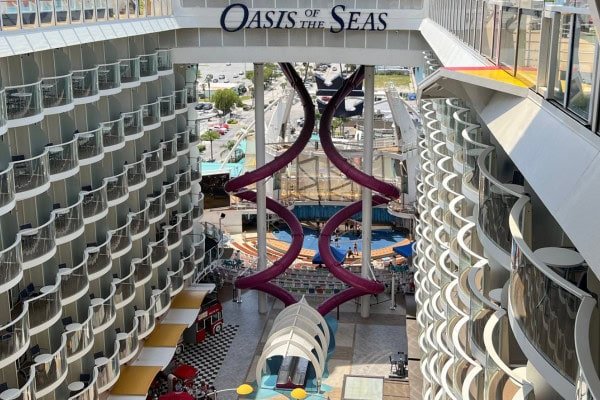
The first truth the ship’s design quietly holds is that your balcony is not an isolated island. It is a node on a vast, interconnected network. Those sweeping promotional shots carefully edit out the sightlines—the downward gaze from public decks above, the acoustic transparency of partitions that can turn a private conversation into an unintended broadcast for your neighbors.
This is the gentle panopticon of the seas. You have the sensation of solitary communion with the ocean’s expanse, yet you occupy a visible, audible cell within the vessel’s grand architecture. For the seeker of pure sanctuary, this can feel like a contract breach. But through an Afro-Futurist lens, it challenges us to refine our understanding of sanctuary itself. The balcony becomes less about escaping the collective and more about mastering your interface with it. The goal shifts from impossible isolation to curating your personal frequency—using curated soundscapes, choosing your moments of quiet, and embracing the understanding that unintended connection is part of the ancient, communal nature of sea travel.
Negotiating with the Unforgiving Interface
The second layer of this reality is elemental. The balcony is sold as a seamless, serene interface with nature. The lived experience is an active, sometimes fierce, negotiation.
This isn’t a design flaw; it’s a core feature. It re-acquaints you with the fundamental truth of maritime journeying: you are not a passive spectator scrolling past a scenic backdrop. You are a participant embedded in a dynamic, powerful system. Your balcony transforms into a biological and digital sensor array. The wind teaches you about the ship’s velocity and the ocean’s breath. The spray carries the salt-code of the sea itself. The faint hum from the aft is the vibrational signature of the engineering heart below decks. This constant feedback is a lesson in environmental awareness and adaptive resilience—principles deeply coded into diasporic wisdom.
The Algorithm of Space and Perceived Value
Beneath the experience lies a system of value, a silent algorithm determining cost. The premium for a balcony—often 50-100% more than an interior cabin—is the cruise line’s calculus for curated access, privacy, and connection. The Afro-Futurist traveler must run their own audit.
Consider the evolution of the “Infinite Veranda” on newer ships: a wall of glass that descends, digitally blurring the line between inside and outside. It offers controlled, weather-proofed access to “open air.” Is this a triumph of tech-enhanced experience, or a gentle, climate-controlled enclosure? It represents simulated nature, a fascinating step in our relationship with the elements.
The value question is personal. For a journey through Alaska’s glacial fjords or under the Nordic aurora, the balcony purchases a front-row seat to planetary-scale cosmic theater—an undeniable worth. For a voyage dominated by port days, where the ship is merely a moving hotel, the algorithm of value may compute differently. The key is to decrypt what you are truly buying: Is it sovereign space, or simply a prettier frame for the same journey?
The Unwritten Protocol of Neighboring Nodes
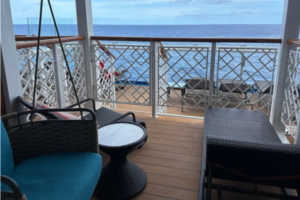
The most human, and often most surprising, layer is the neighbor protocol. On the balcony, you are in close orbital proximity to others. Scents—from a neighbor’s cigar to culinary aromas from distant galleys—drift on the breeze. Sounds travel with clarity: laughter, music, the soft cadence of a foreign language. Your private sensory zone is, in practice, a shared and permeable border.
This can be the cruise’s greatest challenge or its most unexpected gift. It necessitates a form of micro-diplomacy and heightened communal awareness. It echoes ancestral practices of living in proximate community, where respect and conscious coexistence were essential for harmony. The “loud neighbor” ceases to be a mere inconvenience and becomes part of your voyage’s ecosystem, a co-author in the shared story of the journey.
The Verdict: Hacking the Portal for Sovereign Experience
So, does the starlight veranda fulfill its luminous promise? The answer is not a binary yes or no, but a conditional and empowered affirmation.
The balcony is profoundly worth it when you consciously hack its purpose. Do not book it for a marketed fantasy of perfect, sterile solitude. Book it to activate a unique triad of experiential protocols:
- As a Direct Sensor: For the unfiltered data stream of wind, weather, and oceanic presence.
- As a Cosmic Stage: For private, awe-filled communion with nature’s most majestic performances.
- As a Community Simulator: For practicing the art of maintaining self within the collective, of choosing connection on your own terms.
Your mission, visionary traveler, is not to find a non-existent bubble of isolation on a vessel of thousands. Your mission is to strategically hack the spatial code. Decrypt the deck plans. Seek the sheltered alcoves on the ship’s aft. Understand the wind corridors and sun paths. Choose your cabin not just for the view’s panorama, but for its position within the ship’s social and environmental architecture.
Book the balcony not for the sanitized dream, but for the real, windy, resonant, neighborly, and breathtaking reality of it. It is a microcosm of our interconnected world: beautiful, challenging, alive with energy, and perpetually sailing toward the next horizon. Your ancestors crossed these waters with a fixed gaze behind them. You now cross them with a gaze forward, from your own small, potent command deck on the future. Your portal is waiting. Step through, and navigate it wisely.
Chart your own course between tradition and innovation at blickety.us—where travel meets vision.