

Wall Street Embraces Digital Assets: What CME’s Expansion Means for Black Investors
The world’s largest financial derivatives marketplace just made a statement that could reshape wealth-building opportunities for everyday investors: digital assets are officially a legitimate, diversified investment class.
On January 15, CME Group—the Chicago-based exchange that handles trillions in traditional financial contracts—announced plans to launch futures contracts for Cardano, Chainlink, and Stellar on February 9, 2025. This isn’t just another trading product launch. It’s Wall Street’s clearest signal yet that digital asset markets have evolved beyond speculation into regulated, institutional-grade investment infrastructure.
For Black investors historically locked out of early-stage wealth opportunities, this expansion represents both promise and paradox: greater legitimacy and accessibility, but also new gatekeeping mechanisms that could replicate old exclusions. Understanding this shift means understanding how to navigate the next frontier of wealth building—and who gets left behind.
The End of the Two-Asset Digital Market
For years, institutional digital asset investing meant one thing: betting on Bitcoin or Ethereum. The rest of the market existed in a regulatory gray zone that kept most traditional investors on the sidelines.
CME’s latest move signals that era is over. By adding three distinct assets to its regulated futures platform, the exchange is declaring that digital asset infrastructure can handle diverse investment strategies across different use cases and technologies.
The new contracts introduce a two-tier structure designed to serve both institutional heavyweights and active retail traders. Standard and micro contract sizes will be available: 100,000 and 10,000 units for Cardano, 5,000 and 250 units for Chainlink, and 250,000 and 12,500 units for Stellar.
This tiered approach matters because it addresses one of the biggest barriers Black investors face: minimum investment thresholds that price out community wealth. Micro contracts make regulated digital asset exposure accessible to investors who don’t have institutional capital.
Following the Money: Why CME Is Going All-In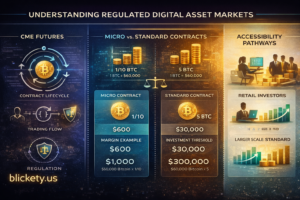
CME didn’t wake up one morning and decide to democratize digital asset investing out of goodwill. The exchange is responding to explosive demand that proved regulated digital asset markets can generate serious revenue.
In 2024, CME reported record digital asset futures and options activity, averaging 278,300 contracts daily. That translates to approximately $12 billion in notional value changing hands every single day—real money flowing through regulated channels instead of offshore platforms.
More telling for long-term institutional adoption: average open interest stood at 313,900 contracts, representing about $26.4 billion in positions held at any given time. These aren’t day-trading gamblers. This is sustained institutional participation in digital asset markets.
The growth engine? The “micro” contract suite that makes regulated trading accessible beyond elite traders. Micro Ethereum futures averaged 144,000 contracts daily, while Micro Bitcoin futures averaged 75,000 daily. When CME hit an all-time volume record of 794,903 contracts on November 21, 2024, micro contracts accounted for 676,088 of them.
The lesson for investors: accessibility drives participation. When barriers come down, community wealth shows up.
The Proven Playbook for Market Graduation
CME isn’t entering this expansion blind. The exchange tested its “graduation playbook” with Solana and XRP in 2024, and those launches proved that regulated markets can pool real liquidity around select digital assets.
By mid-September 2024, more than 540,000 Solana futures contracts had traded since their March launch, representing about $22.3 billion in notional value. XRP showed similar traction with over 370,000 contracts traded since May, totaling roughly $16.2 billion.
These aren’t small numbers. They demonstrate that when assets get regulated infrastructure and trusted venues, institutional money follows—pulling volume away from offshore platforms and into US-regulated environments where investor protections exist.
This precedent is crucial for understanding the Cardano, Chainlink, and Stellar listings. CME is betting these assets have reached “graduated” status where they can support institutional derivatives markets while creating wealth-building opportunities for retail investors.
Why These Three Assets Matter for Portfolio Diversification
CME’s selection reveals how institutional investors are beginning to categorize digital assets beyond simple speculation—and what that means for building diversified portfolios.
Cardano functions as a smart contract platform alternative, allowing investors to gain exposure to decentralized application ecosystems distinct from Ethereum’s dominance. It represents a different technical approach and community, creating real diversification benefits.
Chainlink represents infrastructure investment, serving as exposure to the middleware systems that connect digital applications to real-world data. As institutional adoption grows, these connector systems become increasingly valuable.
Stellar focuses on payments and cross-border value transfer—narratives that resonate during discussions of financial inclusion and accessible global transactions. For communities historically underserved by traditional banking, these use cases have particular relevance.
Critically, the infrastructure for these contracts has existed longer than many realize. CME’s contracts settle based on transparent reference rates that have been tracking these assets for years. This benchmark maturity gives institutional participants confidence that settlement will behave like traditional derivatives markets.
The timing aligns with broader infrastructure improvements. CME announced plans to make digital asset futures and options available 24/7 beginning in early 2026, pending regulatory review. Round-the-clock access removes another barrier for global investors operating across time zones.
The ETF Wave: Retail Access on the Horizon
The strategic importance of CME’s move was confirmed almost immediately when ProShares filed for six new exchange-traded funds tied to these specific assets.
The filings cover standard exposure (ProShares Chainlink ETF, ProShares Cardano ETF, and ProShares Stellar ETF) alongside 2x leveraged versions. While tickers and fees remain to be announced, the filings list an effective date of March 31, 2025.
This timeline reveals an orchestrated sequence: CME futures establish liquidity, hedging capabilities, and reference pricing in February, then structured retail products launch roughly seven weeks later.
For Black investors, ETFs represent more accessible entry points than futures contracts. They trade like stocks, fit naturally into retirement accounts, and don’t require understanding complex derivatives mechanics. This is where the real wealth-building opportunity could emerge—if fees stay reasonable and access remains genuine.
The inclusion of leveraged ETFs is particularly significant because these products rely heavily on regulated futures markets to deliver magnified returns. The CME listing is a functional prerequisite for their existence.
The Accessibility Catch: Who Really Benefits?
Here’s where the promise meets reality. Regulated markets create legitimacy and investor protections, but they also introduce new barriers that could replicate historical patterns of financial exclusion.
Futures contracts, even micro versions, require margin accounts that many retail investors don’t have access to. Minimum account balances, credit checks, and trading qualifications can exclude the very communities who need wealth-building opportunities most.
ETFs solve some accessibility problems but introduce others. Management fees compound over time, eating into returns. Early-stage wealth building happens in direct ownership and early adoption—not in packaged products that arrive after institutional money has already moved in.
The real question for Black investors: Will this expansion create genuine on-ramps to wealth, or just new versions of old gatekeeping?
The answer likely depends on financial literacy and strategic approach. Understanding these markets means recognizing both their potential and their limitations. It means asking hard questions about fees, access requirements, and who actually captures value in these systems.
Measuring Success: What to Watch
The market will quickly determine whether these new contracts become genuine wealth-building tools or occasional hedging instruments for institutions.
Using CME’s 2024 average daily notional of $12 billion as baseline, several scenarios could play out over the first 90 days:
A “soft adoption” scenario capturing 0.1% of share would result in approximately $12 million in combined daily trading. This would sustain the listings but indicate limited institutional integration and minimal retail participation.
A “base case” of 0.5% share would yield roughly $60 million daily—consistent with steady institutional hedging and meaningful retail market-making participation.
A “breakout” scenario with 1.5% share would translate into about $180 million per day, signaling that regulated markets have become genuine venues for diversified digital asset exposure and creating real liquidity for retail investors.
For Black investors, the metrics that matter most aren’t just trading volumes but actual accessibility: Are margin requirements reasonable? Do ETF fees allow long-term wealth building? Can community investors participate without institutional resources?
Building Wealth in the Regulated Digital Asset Era
The CME expansion represents a pivotal moment in financial market evolution—one that could either expand wealth-building opportunities for Black communities or simply create new instruments for existing wealth to compound.
The key is informed participation. Understanding how regulated digital asset markets work, recognizing their limitations, and building investment strategies that align with long-term wealth goals rather than speculation.
This means:
- Educating yourself on how futures and derivatives work before jumping in
- Questioning fees and access requirements to understand true costs
- Diversifying strategically rather than chasing institutional trends
- Thinking generationally about wealth building, not quick returns
- Building community knowledge so financial literacy spreads beyond individuals
The infrastructure is being built. The institutions are committing capital. The question is whether Black investors will have genuine access to the wealth-building opportunities this creates, or if we’ll watch from the sidelines as another financial revolution benefits those who already have access.
The Afro-Futurist vision isn’t just participating in systems designed by others—it’s understanding them well enough to build better ones. As regulated digital asset markets mature, the opportunity exists to demand real accessibility, genuine community benefit, and wealth-building tools that serve those historically excluded from financial opportunity.
Wall Street’s embrace of digital assets is real. The question is whether it will be inclusive, or just another chapter in the long story of financial gatekeeping.
The answer depends partly on how educated, engaged, and demanding Black investors choose to be about access, transparency, and genuine opportunity. The infrastructure is being built. It’s time to ensure it serves community wealth, not just institutional profit.